
$2.6M grant fuels study linking mitochondrial dysfunction to inflammation
Nov. 5, 2025
When we get tired, we rest. If we are hungry, we eat.
Mitochondria, which provide the energy for us to do those things, also need to replenish themselves by cycling out old mitochondria and replacing it with new.
But as we age or if we encounter trauma, that recycling process can be interrupted or slowed. When that happens, leakage of mitochondrial DNA can occur, causing inflammation that has been linked to rheumatoid arthritis, Alzheimer’s disease, liver disease, metabolic disease and other health issues.
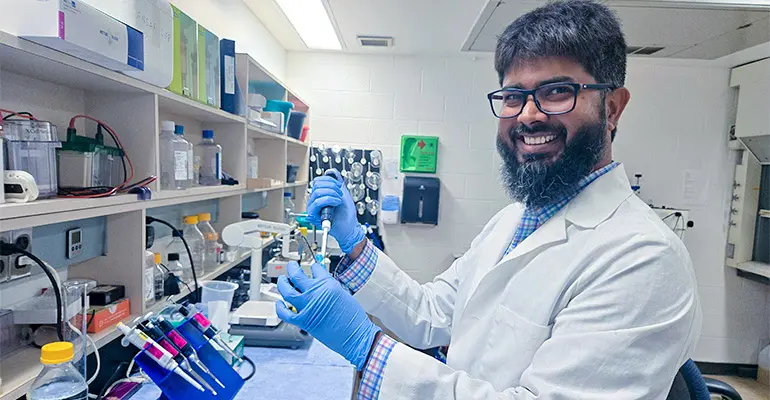
Mohammad Yunus Ansari, Ph.D., assistant professor of biomedical sciences at NEOMED, has studied mitochondrial dysfunction for more than a decade. He recently received a grant to study how mitochondrial DNA leakage promotes inflammation and intervertebral disc degeneration. The award from the National Institute of Arthritis and Musculoskeletal and Skin Diseases (NIAMS) is expected to total $2,635,234 over five years.
“I have been working on the mechanism of how the cell can maintain healthy mitochondria and how it can remove dysfunctional mitochondria. If any of that pathway is compromised then it leads to mitochondrial dysfunction,” Dr. Ansari said.
The current project builds on his work of the last 11 years exploring different angles of mitochondrial dysfunction. In this study, he is exploring how trauma induces mitochondrial dysfunction and how that dysfunction contributes to inflammation.
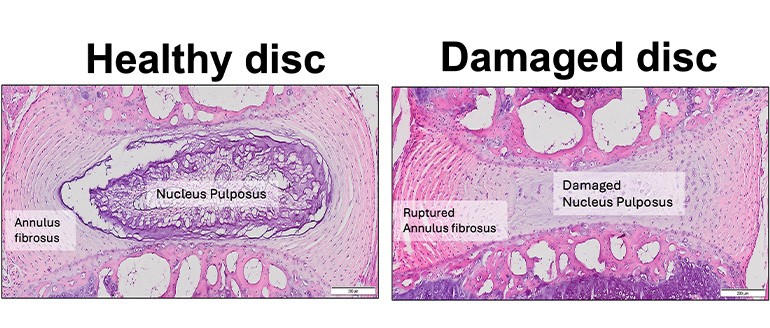
Specifically, Dr. Ansari is examining changes in the spine and loss of flexibility.
“When we are running, we are hitting the ground and the disc is absorbing that shock,” he said, to illustrate the impact of inflammation. “We cannot do those things if the disc is damaged, right? So how the disc is damaged? One of the components is inflammation in the intervertebral disc. This project is to understand what is causing that inflammation.”
Sterile Inflammation
Mitochondria is unique among the organelle within the cell because it has its own DNA. When mitochondrial DNA leakage occurs, the cell reacts as though there is an infection in the cell and creates an inflammatory response.
“We call it a sterile inflammation because there is no infection,” explained Dr. Ansari. “There is no bacterial or viral infection, but our cell is producing inflammatory cytokines because it thinks that there is some infection.”
Dr. Ansari sees this study as a first step toward treatment of health concerns caused by inflammation.
“We are trying to find if mitochondrial DNA leak due to trauma or aging induces inflammation. If the answer is yes, then how we can prevent the leakage of the mitochondrial DNA and find the treatment? The next step is target it, to suppress the pathway leading to inflammation,” he said, explaining the translational aspects of his work. Additionally, he hopes the research leads to future studies on how to clear dysfunctional mitochondria from the cell to prevent leakage.
“If we can prevent the leakage and give this process enough time to clean up the dysfunctional mitochondria, that will help to suppress inflammation,” he said.
Related
Read about Dr. Ansari’s research: “High-resolution 3-dimensional micro-CT imaging of intervertebral discs using a novel contrast agent” in JOR Spine