Rewriting the Script for Improving Healthcare

The Executive Education program at NEOMED provides the tools, knowledge and mentoring to create meaningful change in health systems

The journey of a thousand miles begins with a single step.

That quote, attributed to Lao Tzu, has been used for a couple millennia to demonstrate that impactful change often does not happen in one grand action. Rather it is a series of smaller actions that cumulatively spur progress.

That idea is sometimes lost in approaches to healthcare improvement.

“If you were to go online and look up any sort of healthcare summits or conferences, most of them are geared toward either clinicians and how they practice or they’re targeting healthcare executives, people that work at the macro level of healthcare in making systemic change,” noted Jordan Cinderich, director of operational excellence at Northeast Ohio Medical University. “What we believe in, and what I believe Lean Six Sigma has validated time and time again, is that real, sustainable, impactful change occurs when you get everyone engaged in the health system, making small improvements, and the whole system improves.

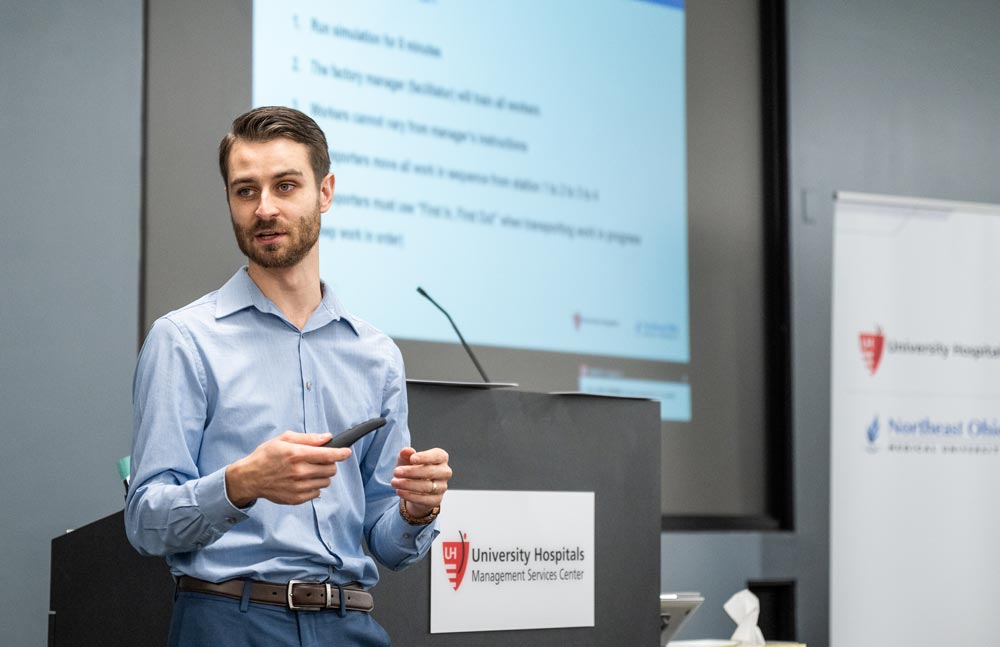
Jordan Cinderich, M.Ed., LSSBB, process engineer and director of the Executive Education program.

“The successes that are going to change healthcare are the everyday actions and improvements of your frontline workers in healthcare,” he asserted.

Among the cases he shared, Cinderich gave the example of a scheduling coordinator who developed an improvement project that changed scheduling wait time from six months to two months.

That example came from a Lean Six Sigma course Cinderich taught through NEOMED’s Executive Education program for employees of University Hospitals of Cleveland. Since 2022, NEOMED and UH have had an affiliation agreement supporting the joint aim of developing leadership and deploying a transformational workforce who heal, teach and discover.

As part of the UH-NEOMED affiliation, UH staff have access to a variety of professional development programs offered through Executive Education. Since launching in March 2024 more than 300 UH employees have participated in LSS and other Executive Education programs through date of publication.

“With some of the workers we have in our program right now, this might be the first improvement project they’ve ever been a part of. [Until now,] they’ve only ‘just done their job,’” noted Cinderich. “Now their health system is telling them, ‘we’re going to educate you and give you the resources to do what you think needs to be improved.’ They come through our program and some of the outcomes of the projects we’re seeing are huge. That clinic or that office is going to be noticeably better because we empowered that one person.”

While one project in one office can create small but meaningful change, empowering employees throughout a health system can turn one meaningful change into thousands.

“If you’re continuously dedicated to this type of workforce development, over time the health of your system will improve,” Cinderich noted.

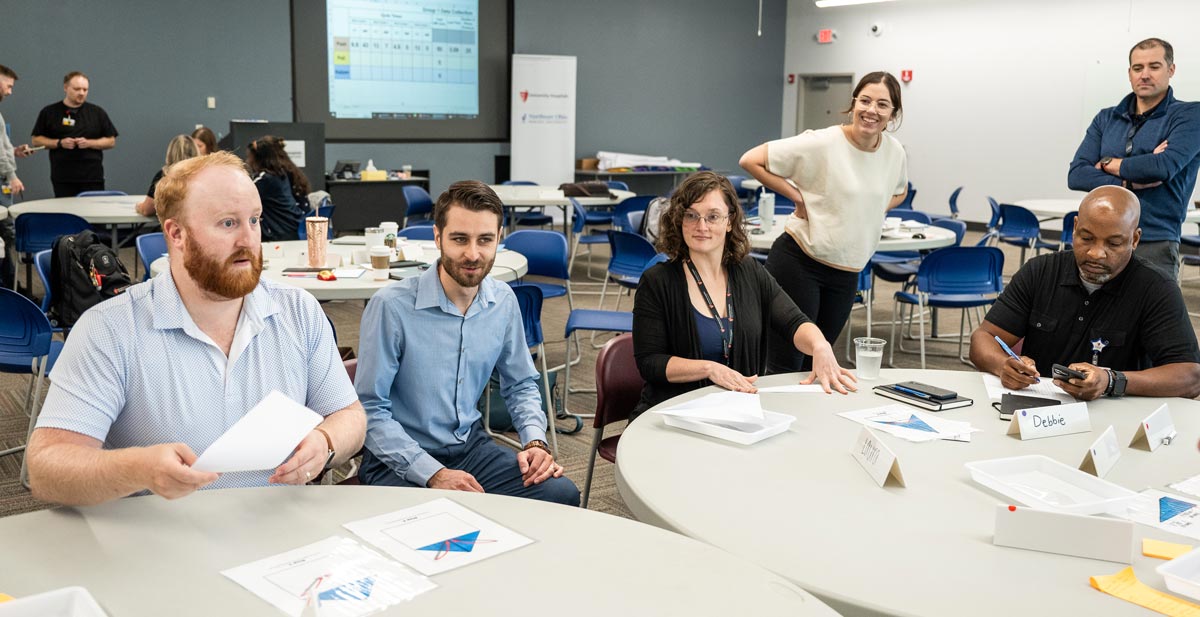
Jordan Cinderich, second from left, leads a Lean Six Sigma class for University Hospitals physicians and other health professionals.

Building the program

The NEOMED Executive Education program grew out of a disparate collection of programs for various professional development needs. For example, Lean Six Sigma training was available for NEOMED employees to learn process improvement. Faculty development programs were available to train NEOMED clinical faculty in certain skills, like research and education.

As NEOMED developed its affiliation with University Hospitals, it made sense to bring the variety of professional development courses together under one program to streamline operations.

“Obviously the hard part about jumping into this new arena is that you’re a small fish in a big pond,” Cinderich said. “Everyone else has been doing this [professional development training] for a long time. So for us to be successful, it wasn’t enough to just have high quality programs. You’ve got to have people that are interested in doing it.”

The NEOMED Difference

Many of the professional development programs marketed to healthcare professionals were not developed with the specific needs of health systems in mind. NEOMED has taken a different approach — looking at those specific needs and developing programs to address them. Even the Lean Six Sigma courses have been retooled to speak directly to the challenges faced by hospitals and health systems. In January 2025, NEOMED’s Lean Six Sigma for Healthcare Operations program earned accreditation by the Council for Six Sigma Certification (CSSC).

Mentoring is another thing NEOMED’s program provides that is not usually incorporated in other development programs.

“Other programs, they just give you the curriculum and then they walk away. We [NEOMED] are giving you the curriculum, we’re mentoring, we’re walking alongside you,” Cinderich said. “We’re providing resources and access to experts who will actually help in achieving outcomes, not just educating employees and walking away.”

“The successes that are going to change healthcare are the everyday actions and improvements of your frontline workers in healthcare.”

— Jordan Cinderich

Health Coaching

One course in the Executive Education menu was added specifically at the request of University Hospitals: A Health and Well-being Coaching certificate.

Over the past decade, evidence-based health and well-being coaching has gained increased attention from health systems as a way to support patient recovery and to help patients manage chronic conditions. The health and well-being coach will assist with mindfulness, goal setting and lifestyle changes to improve well-being.

The six-month program at NEOMED prepares students from various backgrounds with foundational skills and knowledge. Learners study behavior change, coaching psychology, motivational interviewing and coaching techniques. The course is accredited by the National Board for Health and Wellness Coaching (NBHWC) and students who pass the program will be able to apply for the NBHWC exam.

“We’re the only program that educates the students and then facilitates, through our partner hospital, the 50 hours of interaction for our learners need to sit for the exam,” Cinderich noted. That innovation is setting a standard for health and wellness coaching. The accrediting board has indicated that it may begin requiring other programs to provide similar access.

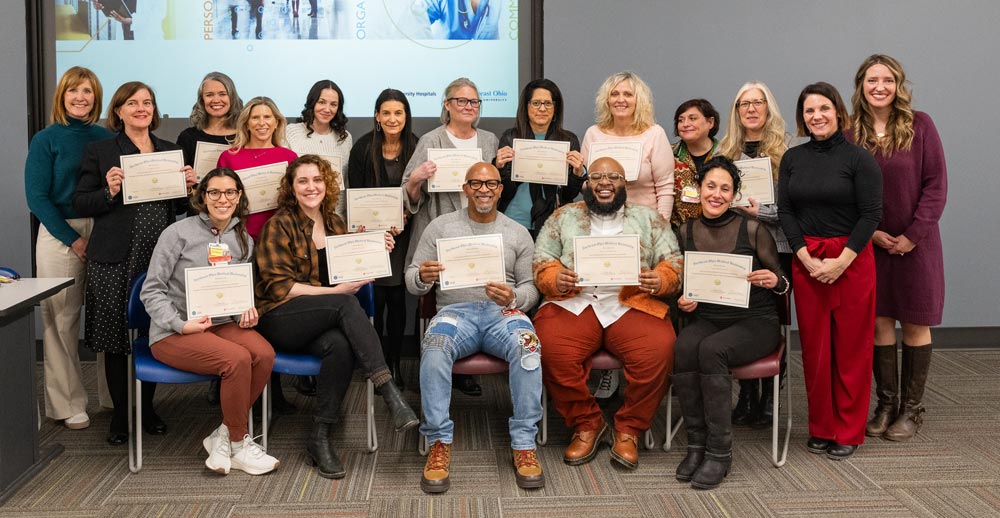
The inaugural cohort of the Health and Well-Being Coaching certificate program.

What’s Next

Cinderich anticipates growing the Executive Education program over the next year, launching new programs and reaching additional learners. Programs are being explored in the areas of leadership, artificial intelligence, data analytics and project management.

“Right now, healthcare is having a hard time,” he noted. “Retaining people and paying for external people to come to their organization that bring those skills, it’s very expensive. It’s cheaper to take the workforce you have that’s already dedicated to your system and train them to do these things that are becoming very important in healthcare.”

In addition to adding new courses, Cinderich would like to look beyond hospital systems to grow the program.

“I’d like to look at healthcare more broadly,” he said. “Right now, we’re focused on our partner hospital systems that feed into our ecosystem here at NEOMED. But healthcare is much more than hospital systems, right? There are other types of clinics. There are public health departments. There are health commissions. There are insurance companies. There are a lot of different parties that feed into healthcare.

“I think over time, if we could bring more of those types of people together, it then situates NEOMED with a very privileged seat to be doing quality improvement and, longitudinally, we will have a unique view of the full value stream of healthcare. When you roll your sleeves up and you help with quality improvement projects and you learn what everyone’s problems are across the whole value stream, then I think you can understand, how do we fix healthcare?”

Even though he is not a clinician who works directly with patients, Cinderich is excited to see the impact of his work on improving the quality of care patients receive.

“We know that in some small way, we’re contributing to healthcare improvement with Executive Education,” he said. “It provides a platform where you take that magnifying glass and get so much closer to seeing healthcare transformation in action, to where we’re designing programs and executing them on a much larger scale. And we’re seeing it firsthand in a shorter period of time. It’s not four years like our med school. It’s 10 months. It’s one year. And you’re seeing data about how our patients are doing now or how much shorter wait time is or how much more compliant we are.

“That is super exciting because I’m not healing patients at the bedside, but I’m doing something that I’m seeing right in front of my eyes that’s contributing to improving healthcare in Northeast Ohio.”
“I’m not healing patients at the bedside, but I’m doing something that I’m seeing right in front of my eyes that’s contributing to improving healthcare in Northeast Ohio.”
— Jordan Cinderich

Ignite Magazine

Marketing and Communications
marcom@380cebbe0d.nxcli.io

Inside Ignite

Ignite home page