When James Parkinson, member of the Royal College of Surgeons, described what he called “shaking palsy” in an 1817 essay, he focused on physical symptoms and made particular note that the patient in his illustrative case was unimpaired in “the powers of his mind.”
Research has since shown that Parkinson’s disease can affect the mind and thought processes, such as attention, mental processing and problem solving, and memory. But it is unclear exactly how cognitive dysfunction in Parkinson’s disease develops and how it can be stopped or slowed.
Fayez Almashhori, a graduate student in biomedical sciences at Kent State University, and Sheila Fleming, Ph.D., discuss research on neurodegeneration in the lab.
Sheila Fleming, Ph.D., associate professor of pharmaceutical sciences at Northeast Ohio Medical University, is trying to solve that puzzle.
Dr. Fleming and her colleague Caryl Sortwell, Ph.D., Michigan State University, received a four-year, $3-million Synergistic Idea Award from the Department of Defense: Congressionally Directed Medical Research Programs to study a new model of cognitive dysfunction in Parkinson’s disease and the impact of exercise.
“We don’t know a lot about how cognitive dysfunction develops and progresses to dementia in Parkinson’s. We need a better understanding of the brain regions involved, the pathology and the cellular mechanisms driving that rise in cognitive dysfunction,” Dr. Fleming said. “We also do not have a lot of treatments specifically for cognitive dysfunction. And the common treatments used for motor impairments can actually make some of the cognitive symptoms worse.”
“We don’t know a lot about how cognitive dysfunction develops and progresses to dementia in Parkinson’s.”
– Sheila Fleming, Ph.D.
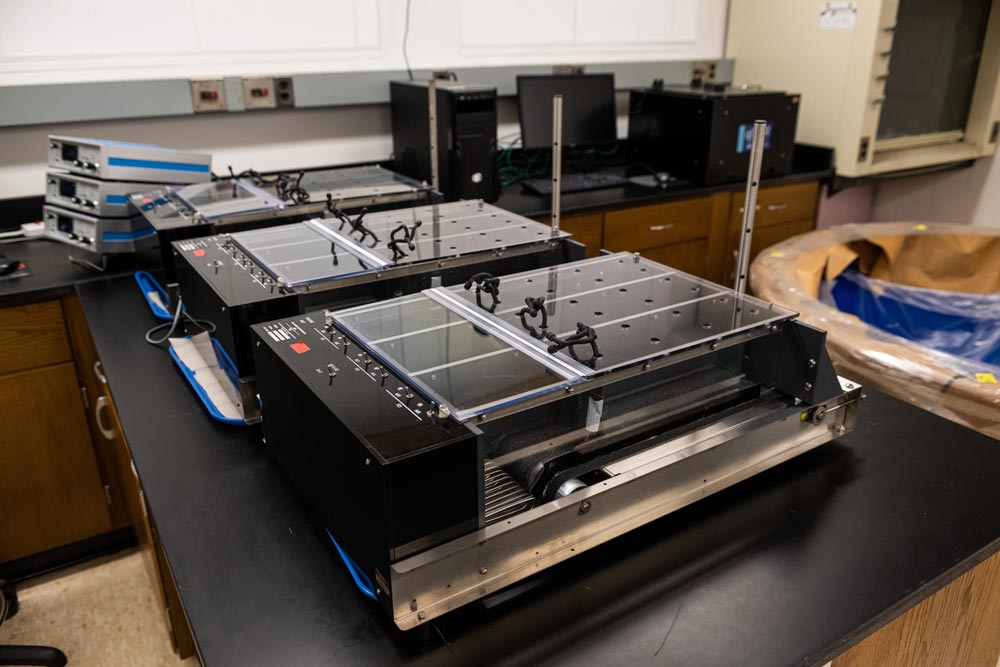
Treadmills are used with an animal model to test the effects of exercise on Parkinson’s symptoms and pathology.
Building on previous work
The two researchers have collaborated for more than decade, most recently on a $2-million award from DoD in 2019 in which they explored the effects of exercise on motor function and slowing or stopping the aggregation of the protein alpha-synuclein, a key protein in Parkinson’s disease pathology.
Important clinical work by Jay Alberts, Ph.D., at the Cleveland Clinic, and others showed that exercise, especially forced exercise (where the exercise rate is significantly higher than the voluntary exercise rate), can improve motor scores in people with Parkinson’s.
Since bicycles were not practical with her animal model, Dr. Fleming chose treadmills to mimic the intensity of the Albert study. “A treadmill forces you to do it. We have more control by using the treadmills and it matches the clinical work better,” she noted.
The elevated plus maze is used to measure anxiety in the animal model.
Since bicycles were not practical with her animal model, Dr. Fleming chose treadmills to mimic the intensity of the Albert study.
“The previous study was really to see if there is a protective effect of exercise in this animal model.”
The current study aims to model stages of cognitive dysfunction in Parkinson’s disease using alpha-synuclein preform fibrils, similar to the previous work.
Why treadmills?
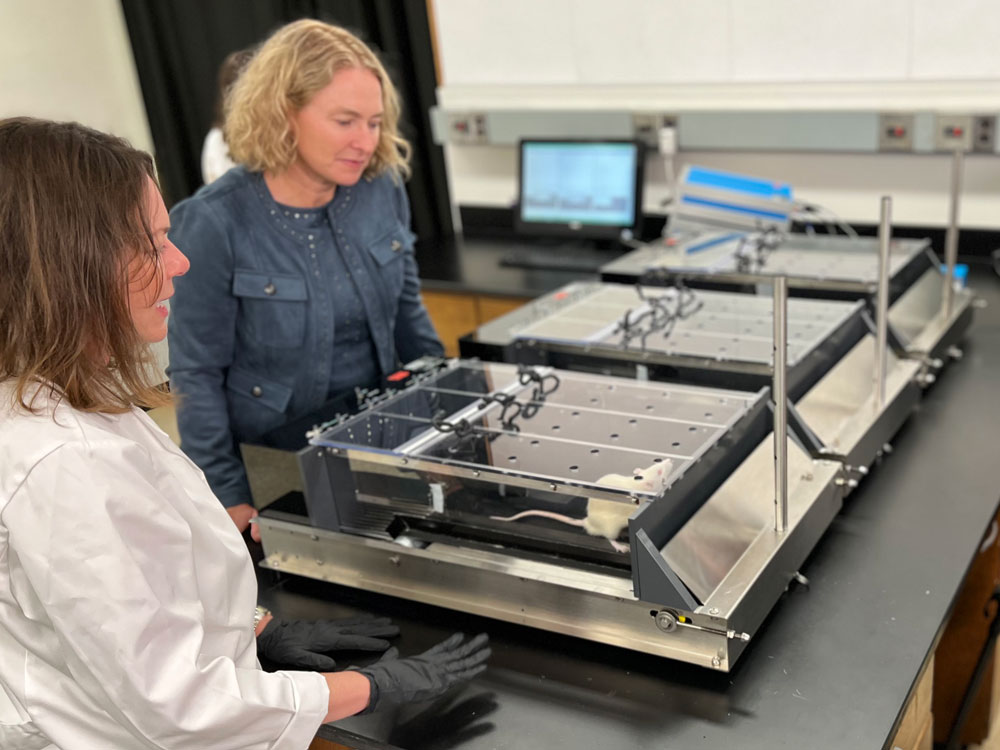
Sheila Fleming, Ph.D., explains the use of treadmills with an animal model in her research on Parkinson’s disease.
“The hallmark pathology in Parkinson’s disease is the development of Lewy bodies and the loss of dopamine neurons in the substantia nigra,” Dr. Fleming explained. “We’re creating a model that has these features but then also adding an injection into a region of the brain that is involved in Parkinson’s with dementia, the basal forebrain. The goal is to have a Parkinson’s disease model without cognitive symptoms, have one with mild/early cognitive impairments, and then have one that progresses to dementia. This will help us better understand how cognitive dysfunction develops in PD and help us identify new strategies for intervention.
Parkinson’s disease research at NEOMED.
Stages of impact
The earlier research in the Fleming lab focused on motor function and examined the impact of exercise at different points of progression.
Their first experiment examined the effect of exercise in the early stages of Parkinson’s disease, before cells begin to die. In the second experiment, there was month-long lag before introducing exercise and the exercise lasted five months in order to determine the impact on neurodegeneration.
“In both cases we used a battery of sensitive behavioral tests that we know are sensitive to varying degrees of neurodegeneration. We also added one cognitive test, an anxiety-related test and an olfactory test, because all of those are non-motor symptoms that can develop in Parkinson’s disease,” Dr. Fleming explained.
Those initial studies showed that exercise had a beneficial effect on motor function but also had a positive effect in the Parkinson’s disease model in the cognitive test.
Sheila Fleming, Ph.D., demonstrates the use of animal treadmills in research with Sara Whittingham, M.D.
Those initial studies showed that exercise had a beneficial effect on motor function but also had a positive effect in the Parkinson’s disease model in the cognitive test.
Pulling out all the stops
With the current study, Dr. Fleming said, “we are pulling out all the stops!”
In addition to the treadmill testing, the study includes a robust battery of cognitive tests exploring different cognitive domains that are affected in Parkinson’s disease.
“In the early to mid-stages of the disease, there are oftentimes problems with executive function; so that’s cognitive flexibility, strategy switching, being able to shift from one topic to another,” Dr. Fleming noted. “The longer you’ve had the disease, the more likely you are to develop cognitive dysfunction.”
In addition to object recognition and memory mazes, operant chambers will be used to test executive function (reversal learning and set shifting) that is often impaired in people with Parkinson’s disease.
Sheila Fleming, Ph.D., looks on as research associate Josephine Lepp pipes samples.
Neurodegenerative disease and aging research at NEOMED.
“Basically, these are tests where you have to train the animals to press a lever to receive a reward, and then you make the reward a little more complicated to receive. With this equipment we can measure the specific executive dysfunction that is found in patients with Parkinson’s disease,” Dr. Fleming shared. “They’ll have to learn that pressing a certain lever results in a reward, but then we change the reward criterion. Now it’s not a lever but a light that leads to the reward. So you’re changing the set; this is set-shifting. Even control animals will make mistakes when you first change it, but then they learn.”
Reversal learning is similar.
“They learn to press a certain lever to get a reward, and then you shift it, so now they have to learn that a different lever is going to give them the reward,” she said.
While the tests may seem simple, they have been shown to reliably demonstrate cognitive deficits in animal models, similar to those uncovered through studies in people with Parkinson’s disease. For example, the Wisconsin card sort test and similar tests are commonly used in the clinic with human subjects and measure the same aspect of cognition.
Developing the model
Sheila Fleming, Ph.D., discusses her research model.
“We found in our earlier study that the Parkinson animals receiving exercise actually showed a reduced fear response in the elevated plus maze, a test of anxiety-like behavior, so we are including two anxiety-related tests in the new project as well,” Dr. Fleming added, hopeful that finding will be replicated and enhanced in her current work.
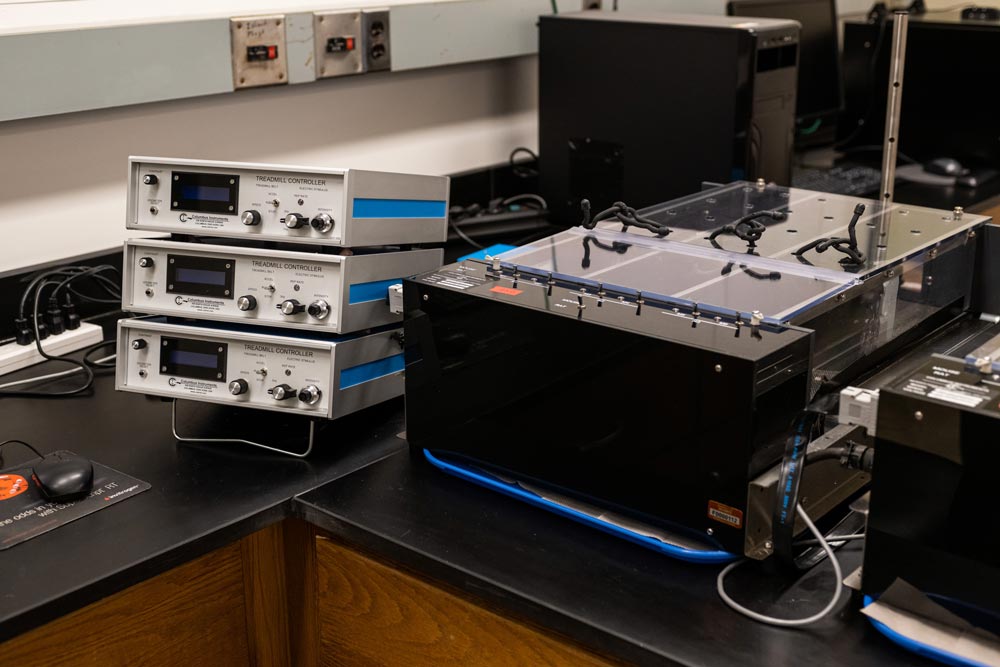
Equipment monitors and controls the speed of the treadmills.
Ultimately, the goal of Dr. Fleming’s research is to find a way to slow or stop the progression of Parkinson’s disease.
Continuing the search
Ultimately, the goal of Dr. Fleming’s research is to find a way to slow or stop the progression of Parkinson’s disease. While that outcome has not been discovered, there is hopeful progress.
“When we looked at our standard neurodegeneration markers, we’re still seeing cell loss,” she noted. “But we are getting changes in behavior. The experiment we’re doing now is going to be looking at genetic profiles within brain regions important for cognitive function to see if we can pick up differences there.”
And if there are changes in the brain?
“If there are detectable changes, then we need to confirm they are driving the behavior. If it turns out to be protective, that would be huge, right? Oh, my gosh. If we can show a biological basis for the beneficial effect of exercise on cognition in Parkinson’s disease, that’d be amazing.”